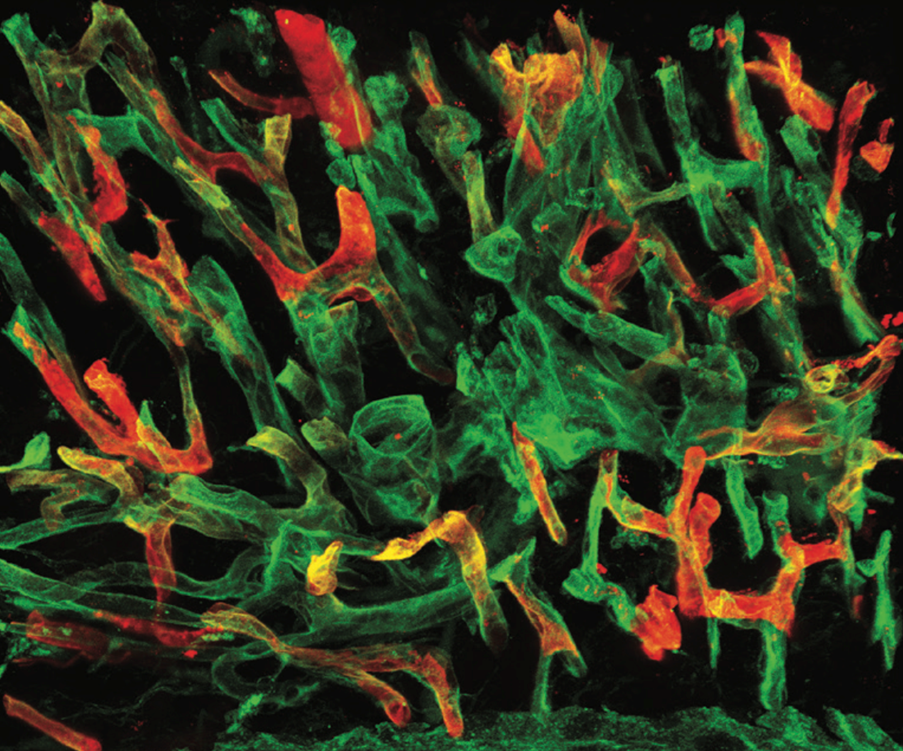
Vascular growth factors and their inhibitors hold significant potential for treating a wide range of human diseases. Our research focuses on their preclinical and translational applications, with the goal of restoring homeostasis and improving tissue function in cardiovascular and other diseases.
Our goal is to develop novel therapeutic approaches by leveraging insights into the biology of vascular endothelial growth factors (VEGFs), angiopoietins (Ang), and the processes of blood vessel growth (angiogenesis) and lymphatic vessel growth (lymphangiogenesis). Current treatments for cardiovascular diseases and cancer are often insufficient or unsuitable for many patients, highlighting the urgent need for new therapies. While inhibition of blood vessel growth is already used in clinical practice, its success has been limited. Conversely, attempts to stimulate angiogenesis and the development of collateral arteries (arteriogenesis) to treat tissue ischemia have largely been unsuccessful.
We investigate the functions and translational potential of vascular growth factors and receptors that we have discovered. Our findings have led to clinical trials for lymphedema and eye diseases, and our discovery of a meningeal lymphatic system has opened the door to analyzing its role in central nervous system diseases. We utilize molecular genetic models, functional genomics, single-cell transcriptomics, proteomics, and metabolomics, along with viral vectors for gene delivery and biologics that block growth factor–receptor interactions. These cutting-edge technologies enable us to advance treatments for cardiovascular and other diseases.
Our work on vascular endothelial growth factors and related pathways opens new opportunities to explore therapeutic options for diseases in which the vasculature plays a critical role.
Members of the VEGF family, consisting of five mammalian proteins, are key regulators of blood and lymphatic vessel development. VEGFs promote angiogenesis and lymphangiogenesis by activating VEGF receptor (VEGFR) tyrosine kinases in endothelial cells. In both physiological and pathological angiogenesis, hypoxia triggers VEGF production, which stimulates vessel growth primarily through VEGFR-2, while VEGFR-1 mainly functions as a decoy receptor with minimal signaling activity. Although VEGF-blocking antibodies have been successfully used in cancer therapy, efforts to use VEGF for proangiogenic therapy in tissue ischemia have been limited by VEGF-induced vascular leakage and abnormal vessel growth.
Since its discovery 30 years ago, we have demonstrated that VEGF-B can protect against myocardial infarction by expanding the coronary vasculature and increasing cardiac muscle mass. Moreover, VEGF-B expression is reduced in failing hearts. These findings suggest that VEGF-B therapy offers a unique opportunity to remodel the myocardial vasculature and enhance cardiac blood flow. Our studies also indicate that VEGF-B can improve glucose and insulin tolerance by expanding the vasculature in adipose tissue.
In adults, VEGFR-3, the receptor for VEGF-C and VEGF-D, is expressed primarily in the lymphatic vasculature, where VEGF-C regulates lymphatic vessel growth. However, VEGFR-3 is also expressed in blood vessels during angiogenesis. In 2015, we discovered a meningeal lymphatic vessel system surrounding the brain. Subsequent studies are investigating the roles of VEGF-C/VEGFR-3 in cerebrovascular dynamics, cerebrovascular fluid drainage, and cellular trafficking in both homeostasis and disease models, including neuroinflammatory and neurodegenerative conditions.
We discovered the endothelial Tie receptor tyrosine kinase (now known as Tie1) in 1992. It is now established that angiopoietins (Ang1, Ang2, and Ang4), ligands of the Tie1/2 receptor complex, are essential for vascular stabilization following angiogenesis. We have demonstrated that the Tie2 receptor is atheroprotective, that Ang2 blockade reduces neuroinflammation and that Ang2 mutations are linked to human lymphedema. Furthermore, we showed that VEGF-C mediated lymphangiogenesis requires autocrine Ang2 signaling in lymphatic endothelial cells. Given its unique role in vascular stability, the Ang-Tie signaling pathway represents a promising therapeutic target for diseases characterized by vascular dysfunction.

Current Group members
Andrey Anisimov, Ph.D., Adjunct Professor
Aino Tedeton, Ph.D.
Antila, S, Chilov, D, Nurmi H, Li Z, Näsi A, Gotkiewicz M, Sitnikova V, Jäntti H, Acosta N, Koivisto H, Ray J, Keuters MH, Sultan I, Scoyni F, Trevisan D, Wojciechowski S, Kaakinen M, Dvořáková L, Singh A, Jukkola J, Korvenlaita N, Eklund L, Koistinaho J, Karaman S, Malm T, Tanila H, Alitalo K. Sustained meningeal lymphatic vessel atrophy or expansion does not alter Alzheimer’s disease-related amyloid pathology. Nat Cardiovasc Res 3: 474-491, 2024.
Sultan I, Ramste M, Peletier P, Hemanthakumar KA, Ramanujam D, Tirronen A, von Wright Y, Antila S, Saharinen P, Eklund L, Mervaala E, Ylä-Herttuala S, Engelhardt S, Kivelä R, Alitalo K. Contribution of VEGF-B-Induced Endocardial Endothelial Cell Lineage in Physiological Versus Pathological Cardiac Hypertrophy. Circ Res. 134:1465-1482, 2024.
Anisimov A, Fang S, Hemanthakumar KA, Örd T, van Avondt K, Chevre R, Toropainen A, Singha P, Gilani H, Nguyen SD, Karaman S, Korhonen EA, Adams RH, Augustin HG, Öörni K, Soehnlein O, Kaikkonen MU, Alitalo K. The angiopoietin receptor Tie2 is atheroprotective in arterial endothelium. Nat Cardiovasc Res. 2:307-321, 2023.
Li Z, Antila S, Nurmi H, Chilov D, Korhonen EA, Fang S, Karaman S, Engelhardt B, Alitalo K. Blockade of VEGFR3 signaling leads to functional impairment of dural lymphatic vessels without affecting autoimmune neuroinflammation. Sci Immunol. 8:eabq0375, 2023.
Leppäpuska IM, Hartiala P, Suominen S, Suominen E, Kaartinen I, Mäki M, Seppänen M, Kiiski J, Viitanen T, Lahdenperä O, Vuolanto A, Alitalo K, Saarikko AM. Phase 1 Lymfactin® study: 24-month efficacy and safety results of combined adenoviral VEGF-C and lymph node transfer treatment for upper extremity lymphedema. J Plast Reconstr Aesthet Surg. 75:3938-3945, 2022.
Results of phase I clinical trial on adenoviral VEGF-C in lymphedema.
Korhonen EA, Murtomäki A, Jha SK, Anisimov A, Pink A, Zhang Y, Stritt S, Liaqat I, Stanczuk L, Alderfer L, Sun Z, Kapiainen E, Singh A, Sultan I, Lantta A, Leppänen VM, Eklund L, He Y, Augustin HG, Vaahtomeri K, Saharinen P, Mäkinen T, Alitalo K. Lymphangiogenesis requires Ang2/Tie/PI3K signaling for VEGFR3 cell-surface expression. J Clin Invest. 132(15):e155478, 2022
This study explains the mechanism by which angiopoietin2 and Tie1 mutations cause lymphedema.
Leppänen VM, Brouillard P, Korhonen EA, Sipilä T, Jha SK, Revencu N, Labarque V, Fastré E, Schlögel M, Ravoet M, Singer A, Luzzatto C, Angelone D, Crichiutti G, D’Elia A, Kuurne J, Elamaa H, Koh GY, Saharinen P, Vikkula M, Alitalo K. Characterization of ANGPT2 mutations associated with primary lymphedema. Sci Transl Med 12: eaax8013, 2020.
Discovery of mutations in angiopoietin 2 growth factor gene in primary lymphedema patients
Antila S, Karaman S, Nurmi H, Airavaara M, Voutilainen MH, Mathivet T, Chilov D, Li Z, Koppinen T, Park J-H, Fang S, Aspelund A, Saarma M, Eichmann A, Thomas J-L, Alitalo K. Development and plasticity of meningeal lymphatic vessels. J Exp Med 214: 3645-3667, 2017.
Meningeal lymphatics develop postnatally and require continuous VEGF-C stimulation for maintenance.
Aspelund A, Antila S, Proulx ST, Karlsen TV, Karaman S, Detmar M, Wiig H, Alitalo K. A dural lymphatic vascular system that drains brain interstitial fluid and macromolecules. J Exp Med 212: 991-9, 2015.
Listed amongst the 10 Breakthroughs of 2015 by Science and as one of 10 Notable advances 2015 by Nature Medicine.
Aspelund A, Tammela T, Antila S Nurmi H, Leppänen VM, Zarkada G, Stanczuk L, Francois M, Mäkinen T, Saharinen P, Immonen I, Alitalo K. The Schlemm’s canal is a VEGF-C/VEGFR-3-responsive lymphatic-like vessel. J Clin Invest 124: 3975-3986, 2014.
Schlemm’s canal that regulates intraocular pressure is a target of the lymphangiogenic growth factor VEGF-C.