We have a long-standing interest in studying mechanisms of organ/tissue interactions that maintain homeostatic balance and, on the other hand, dynamically respond to disturbances.
The lymphatic system presents an excellent model for studying short- and long-range tissue interactions in the context of adaptive immunity since lymphatics connect peripheral tissues to systemic circulation via tissue fluid draining and leukocyte trafficking. Further, the interactions between tissue compartments and cell types are dynamic and amenable to live-imaging approaches.
Recent years have revolutionized our understanding of the role of the lymphatic system in the control of adaptive immunity. To start an adaptive immune response, lymphatic vessel endothelium actively recruits antigen-presenting dendritic cells, to the lymphatic vessel lumen and, subsequently, guides them into the lymph nodes. In the lymph nodes, dendritic cells present the antigens and activate pathogen-specific T cells.
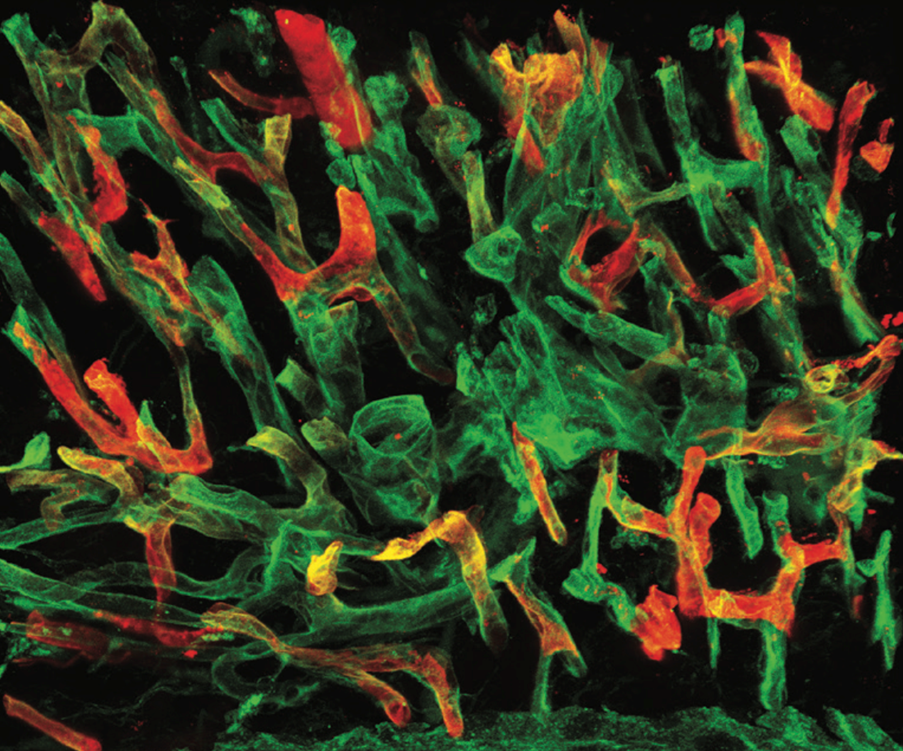
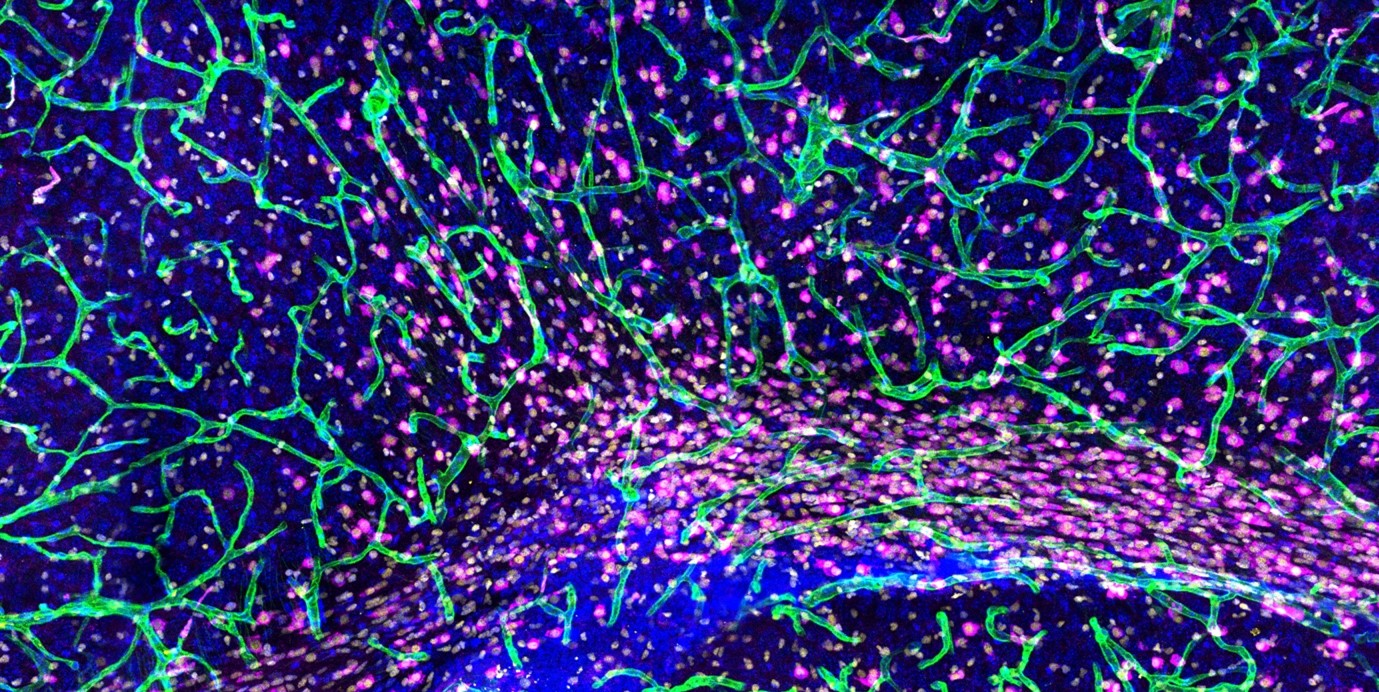
Our research group focuses on two key events that are essential for efficient antigen delivery into the lymph nodes. First, we explore how sprouting lymphangiogenesis is controlled to yield a well-structured functional lymphatic vessel network. Second, we investigate how lymphatic endothelium guides dendritic cell entry into the lymphatic system. To address these questions, we use in vivo models, tissue explants, primary cell co-culture assays, and state-of-the-art microscopy.
We expect that our studies form a basis for strategies to treat patients suffering from diseases in which inflammation is an essential component.

Current Group members
Amanda Macke, postdoc
Maria Saario, postdoc
Jeremia Saari, PhD student
Mario Karam, PhD student
Liaqat I., Hilska I., Saario M., Jakobsson E., Crivaro M., Peränen J., Vaahtomeri K. Spatially targeted chemokine exocytosis guides transmigration at lymphatic endothelial multicellular junctions. EMBO J. 2024 Aug;43(15):3141-3174. doi: 10.1038/s44318-024-00129-x
Alve S., Gramolelli S., Jukonen J., Juteau S., Pink A., Manninen A., Hänninen S., Monto E., Lackman MH., Carpén O., Karaman S., Saharinen P., Vaahtomeri K., Ojala PM. DLL4-Notch3-WNT5B axis mediates bi-directional pro-metastatic crosstalk between melanoma and lymphatic endothelial cells. JCI Insight. 2024 Jan 9;9(1):e171821. doi: 10.1172/jci.insight.171821
Can Ucar M., Hannezo E. , Tiilikainen E., Liaqat I., Jakobsson E., Nurmi, H., Vaahtomeri K. Self-organized and directed branching results in optimal coverage in developing dermal lymphatic networks. Nat Commun. 2023 Sep 21;14(1):5878. doi: 10.1038/s41467-023-41456-7
Korhonen E. A., Murtomäki A., Jha S.K., Anisimov A., Pink A., Zhang Y., Stritt S., Liaqat I., Stanczuk L., Alderfer L., Sun Z., Kapiainen E., Singh A., Sultan I., Lantta A., Leppänen V.M., Eklund L., He Y., Augustin H.G., Vaahtomeri K., Saharinen P., Mäkinen T., Alitalo K. Lymphangiogenesis requires Ang2/Tie/PI3K signaling for VEGFR3 cell surface expression.
J Clin Invest. 2022 Aug 1;132(15):e155478. doi: 10.1172/JCI155478
Vaahtomeri K., Moussion C., Hauschild R., Sixt M. Shape and function of interstitial chemokine CCL21 gradients are independent of heparan sulfates produced by lymphatic endothelium. Front Immunol. 2021 Feb 25:12:630002. doi: 10.3389/fimmu.2021.630002
Vaahtomeri K., Brown M., Hauschild R., De Vries I., Leithner AF., Mehling M., Kaufmann WA., Sixt M. Locally triggered release of chemokine CCL21 promotes dendritic cell transmigration across lymphatic endothelia. Cell Rep. 2017 May 2;19(5):902-909. doi: 10.1016/j.celrep.
2017.04.027
Russo E., Teijeira A., Vaahtomeri K., Wilbrodt, AH., Bloch, JS., Nitschke, M., Santambrogio, L., Kerjaschki, D., Sixt, M., Halin, C. Intralymphatic CCL21 Promotes Tissue Egress of Dendritic Cells through Afferent Lymphatic Vessels. Cell Rep. 2016 Feb 23;14(7):1723-1734. doi: 10.1016/j.celrep.
2016.01.048
Schwarz J., Bierbaum V., Vaahtomeri K., Hauschild R., Brown M., de Vries I., Leithner A., Reversat A., Merrin J., Tarrant T., Bollenbach T., Sixt M. Dendritic cells interpret Haptotactic Chemokine Gradients in a manner governed by signal-to-noise ratio and dependent on GRK6. Curr Biol. 2017 May 8;27(9):1314-1325. doi: 10.1016/j.cub.2017.04.004
Brown M., Johnson LA., Leone DA., Majek P., Vaahtomeri K., Senfter D., Bukosza N., Schachner H., Asfour G., Langer B., Hauschild R., Parapatics K., Hong YK., Bennett KL., Kain R., Detmar M., Sixt M., Jackson DG., Kerjaschki D. Lymphatic exosomes promote dendritic cell migration along guidance cues. J Cell Biol. 2018 Jun 4;217(6):2205-2221. doi: 10.1083/jcb.201612051