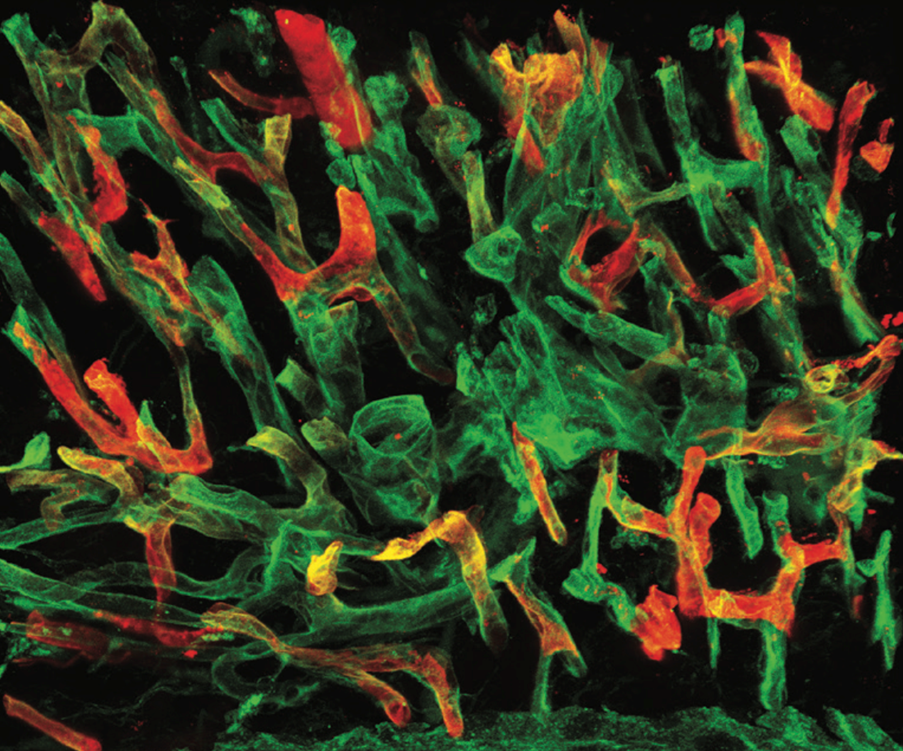
We study vessels, their organ-specific properties and responses to diseases.
Blood vessels wire the entire body and act as highways for fast and efficient transport of nutrients, hormones, cells, and waste products between tissues. Depending on the organ they reside in, blood vessels show different characteristics and perform various functions. For instance, sinusoidal blood vessels, which have larger gaps between endothelial cells, allow the passage large macromolecules and help the liver to carry out its filtration function. On the other hand, the specialized capillaries of the brain form a tight barrier to strictly regulate what can cross into the brain tissue. How the vessels of different organs acquire and maintain such varying phenotypes and functions is still a topic for further investigation.
Our current research focus is to understand the pathological changes that occur in the endothelial cells of various organs in metabolic diseases. Both obesity and diabetes are strongly linked to cardiovascular diseases and endothelial cell dysfunction. However, the mechanisms by which these diseases affect organ-specific vessels are not yet fully known.
We aim to uncover these mechanisms by using mouse models of metabolic diseases and patient samples, followed by molecular analyses of the isolated endothelial cells and their interactions with the stromal and parenchymal cells. The results from these studies will allow us to understand the pathological processes that lead to disease progression. Such deeper understanding is of utmost importance in the development of novel modes of prevention and treatment of pathological changes and in improvement of patient health by reducing cardiovascular complications of obesity and diabetes.

Current Group members
Emmi Pakarinen, Postdoctoral fellow
Satu Paavonsalo, Doctoral student
Yelin Subashi, Doctoral student
Madeleine Lackman, Doctoral student
Alexandra Mäkelä, Master’s student
Selvin Yildiz, Master’s student
Mari Jokinen (Bioanalyst / research technician)
Sangeetha Hariharan (Doctoral student)
Akseli Bonsdorff (Medical student)
Sonja Leppänen (Undergraduate student)
Noora Vilander (Technical trainee)
Amanda Ranta (Undergraduate student, completed BSc thesis in the group)
A closer look at adipose tissue lymphatics and their markers. Lackman MH, Subashi Y, Karaman S. Curr Opin Hematol. 2022 Feb 25
Interplay of vascular endothelial growth factor receptors in organ-specific vessel maintenance. Karaman S, Paavonsalo S, Heinolainen K, Lackman MH, Ranta A, Hemanthakumar KA, Kubota Y, Alitalo K. J Exp Med. 2022 Mar 7;219(3):e20210565
Capillary Rarefaction in Obesity and Metabolic Diseases-Organ-Specificity and Possible Mechanisms. Paavonsalo S, Hariharan S, Lackman MH, Karaman S. Cells. 2020 Dec 14;9(12):E2683.
Vascular endothelial growth factor signaling in development and disease. Karaman S, Leppänen VM, Alitalo K. Development. 20 Jul 2018;145(14). pii: dev151019
Development and plasticity of meningeal lymphatic vessels. Antila S, Karaman S, Nurmi H, Airavaara M, Voutilainen M, Mathivet T, Chilov D, Li Z, Koppinen T, Park JH, Fang S, Aspelund A, Saarma M, Eichmann A, Thomas JL, Alitalo K. J Exp Med. 15 Nov 2017. pii: jem.20170391
VEGFR3 modulates vascular permeability by controlling VEGF/VEGFR2 signaling. Heinolainen K, Karaman S, D’Amico G, Tammela T, Sormunen R, Eklund L, Alitalo K, Zarkada G. Circ Res. 28 Apr 2017;120(9):1414-1425.
Transgenic overexpression of VEGF-C induces weight gain and insulin resistance in mice. Karaman S, Hollmén M, Yoon SY, Alkan HF, Alitalo K, Wolfrum C, Detmar M. Sci Rep. 11 Aug 2016;6:31566
Blockade of VEGF-C and VEGF-D modulates adipose tissue inflammation and improves metabolic parameters under high-fat diet. Karaman S, Hollmén M, Robciuc MR, Alitalo A, Nurmi H, Morf B, Buschle D, Alkan HF, Ochsenbein AM, Alitalo K, Wolfrum C, Detmar M. Mol Metab. 4 Dec 2014;4(2):93-105.