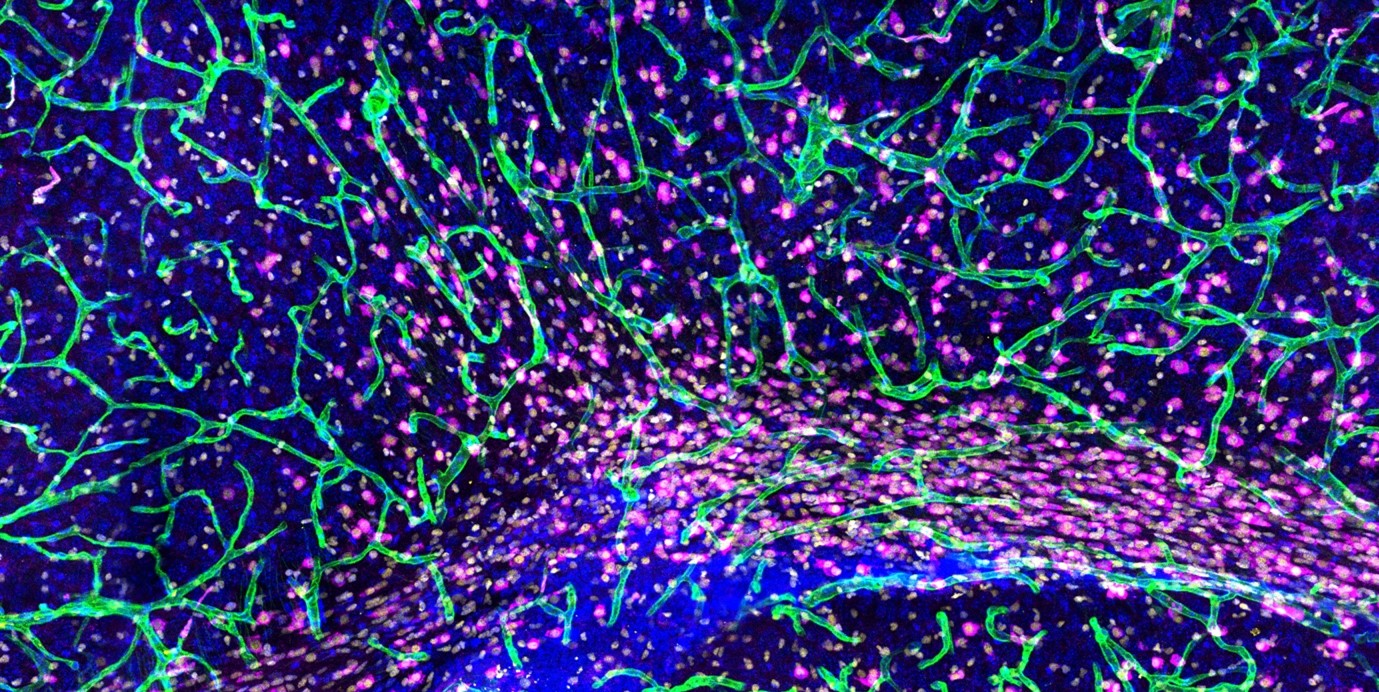
Our research focuses on the cells of the vascular wall, exploring their biology, functional roles and involvement in cardiovascular disease processes. We leverage genetics, functional genomics, high-throughput experimental platforms, and bioinformatics to dissect how genetic variation contributes to vascular pathology.
Vascular diseases are the world-wide leading cause of death, and atherosclerotic coronary artery disease is a major contributor to the mortality. The implementation of effective therapies to modify risk profiles related to classical environmental and metabolic factors have provided significant decreases in cardiovascular disease, but these modifications only decrease events partially.
The remainder of the risk is attributable to common inherited genetic variation that affects molecular pathways in the vessel wall and have remained largely unidentified and untreated. Our group uses genome-wide association studies as a foundation to study how genetic variation affects genes that mediate disease pathophysiology in vascular cells, and how these genes interact in causal gene regulatory networks and further on modulate disease risk.
Vasculature plays a crucial role in coronary artery disease and other cardiovascular diseases as endothelial cells and smooth muscle cells have been shown to contribute the greatest enrichment of disease heritability. Therefore, we are interested in regions of the genome and genes that modulate endothelial and smooth muscle cell function, and we further aim to understand the interactions between these vascular cell types in disease processes. To achieve this, we combine bioinformatic prioritization methods, high-throughput experimental screens in vivo and in vitro and microfluidic chip systems.
We ultimately aim to unravel novel genes and mechanisms of disease that can be targeted with new therapies. In larger picture, characterization of the vascular disease network will advance our understanding of the disease mechanisms by which these cell types in the vascular wall control the disease risk.
Current Group members
Markus Ramste, MD, PhD, Principal Investigator
Nuutti Lahtinen, MSc, PhD Student
Tuulia Niittuinperä, BSc, MD/PhD Student
Sonja Huhdanpää, MSc, PhD Student
Elias Kujanpää, MD Student
Ramste M, Weldy C, Kundu S, Zhao Q, Li D, Brand K, Sharma D, Ramste A, Jagoda E, Ray J, Caceres RD, Galante J, Gschwind AR, Lahtinen N, Nguyen T, Amrute JM, Park CY, Kim JB, Kaikkonen MU, Stitziel NO, Steinmetz L, Kundaje A, Engreitz JM, Quertermous T. Enhancer-targeting CRISPR screens at coronary artery disease loci suggest shared mechanisms of disease risk. medRxiv [Preprint]. 2025 Sep 2:2025.08.28.25334684. doi: 10.1101/2025.08.28.25334684. PMID: 40950476; PMCID: PMC12424881. Under review
Tervi A*, Ramste M*, Abner E, Cheng P, Lane JM, Maher M, Valliere J, Lammi V, Strausz S, Riikonen J, Nguyen T, Martyn GE, Sheth MU, Xia F, Docampo ML, Gu W; FinnGen, Estonian Biobank research team; Esko T, Saxena R, Pirinen M, Palotie A, Ripatti S, Sinnott-Armstrong N, Daly M, Engreitz JM, Rabinovitch M, Heckman CA, Quertermous T, Jones SE, Ollila HM. Genetic and functional analysis of Raynaud’s syndrome implicates loci in vasculature and immunity. Cell Genom. 2024 Aug 9:100630. doi: 10.1016/j.xgen.2024.100630. Epub ahead of print. PMID: 39142284. *equal contribution
Räsänen M, Degerman D, Nissinen T A, Miinalainen I, Kerkelä R, Siltanen A, Backman JT, Mervaala E, Hulmi JJ, Kivelä R and Alitalo K. VEGF-B gene therapy inhibits doxorubicin-induced cardiotoxicity by endothelial protection. Proc Natl Acad Sci U S A. 2016 Nov 15;113(46):13144-13149. PMCID: PMC5135329.
Räsänen M, Sultan I, Paech J, Hemanthakumar KA, Yu W, He L, Tang J, Sun Y, Hlushchuk R, Huan X, Armstrong E, Khoma OZ, Mervaala E, Djonov V, Betsholtz C, Zhou B, Kivelä R, Alitalo K. VEGF-B Promotes Endocardium-Derived Coronary Vessel Development and Cardiac Regeneration. Circulation. 2021 Jan 5;143(1):65-77. Nov 18. PMID: 33203221.
Ramste M, Ritvos M, Häyrynen S, Kiiski JI, Niemi M, Sinisalo J. CYP2C19 loss-of-function alleles and use of omeprazole or esomeprazole increase the risk of cardiovascular outcomes in patients using clopidogrel. Clin Transl Sci. 2023 Aug 8. PMID: 37551775.
Kallström A, Holopainen I, Kambur O, Perola M, Salomaa V, Havulinna A, Ramste M*, Sinisalo Juha*. Divergent trends in the incidence and mortality of coronary events, especially in women. Evidence from Finland in 1996-2021. Ann Med. 2024 Dec;56(1):2424455. doi: 10.1080/07853890.2024.2424455. Epub 2024 Nov 26, *equal contribution
Sultan I, Ramste M, Peletier P, Hemanthakumar KA, Ramanujam D, Tirronen A, von Wright Y, Antila S, Saharinen P, Eklund L, Mervaala E, Ylä-Herttuala S, Engelhardt S, Kivelä R, Alitalo K. Contribution of VEGF-B-Induced Endocardial Endothelial Cell Lineage in Physiological Versus Pathological Cardiac Hypertrophy. Circ Res. 2024 May 24;134(11):1465-1482. doi: 10.1161/CIRCRESAHA.123.324136. Epub 2024 Apr 24. PMID: 38655691.